


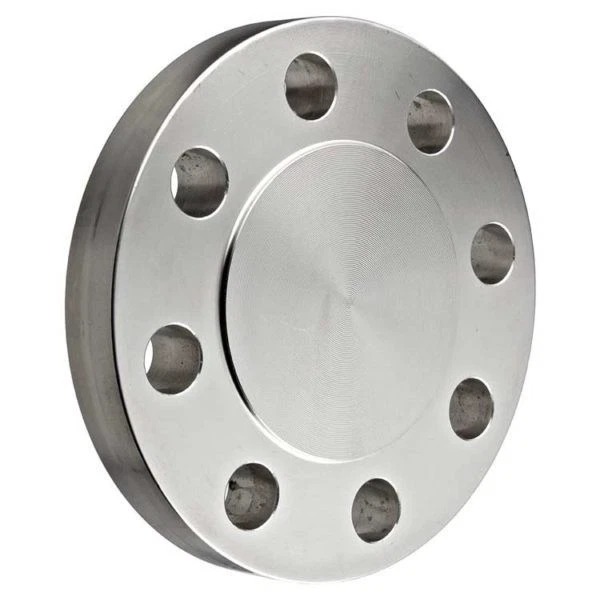
Blind Flange
Blind flange is like a flange cover, also called blind disk or flanged pipe plug. Blind flange has no holes in the center, used to seal the pipe opening. Its function is similar to a pipe plug or pipe cap, but it is detachable, making it easier to replace or perform maintenance. It is essentially a solid disk bolted to the end of a pipe to prevent the flow of fluids or gases.Key Features of Blind Flanges
- Purpose: Used to close off the ends of pipes, valves, or equipment, ensuring a secure seal.
- Design: Flat structure with no central opening, preventing any flow.
- Material: Carbon steel, stainless steel, alloy steel, copper, aluminum, etc.
- Applications: Oil & gas, chemical processing, water treatment, and industrial systems.
- Installation: Bolted to piping systems with gaskets to ensure tight sealing.
Our Supply Range
- Material: Carbon, Alloy and Stainless Steel
- Standards: ASTM A105, ASTM A182
- Sizes: 1/2” to 24”, Customized up to 48”
- Thickness: Schedule 10(S) to SCH 160
- Pressure Ratings: Class 150 to 2500
- Face Type: RF, RTJ
Major Function – Where to Use
The main function of a blind flange is to completely isolate the production medium. It prevents leakage and ensures safety during operation. It is commonly installed at equipment nozzles, before and after shut-off valves, or between two flanges. In some cases, a figure 8 blind flange is recommended, while standard round blind flanges are used for single operations like pressing and purging.Sealing Surface
Blind flanges come with various sealing surfaces such as flat, convex, concave, grooved, and ring joint surfaces.Material Types and Standards
Blind flanges are commonly manufactured using carbon steel, stainless steel, alloy steel, copper, and aluminum. Example: Carbon Steel Blind Flange – ASTM A105Manufacturing Standards
- ASME B16.5
- BS 3293
- DIN 86029
Dimensions
- OD Range: 1/2” to 24”
- Special Sizes: Up to 60”
- Class Range: 150, 300, 400, 600, 900, 1500, 2500
- Face Types: RF (Raised Face), RTJ (Ring Type Joint)
Manufacturing Types and Costs
There are four main manufacturing processes: forging, casting, cutting from plates, and casting combined with forging. Forging is the most expensive but offers the best quality, while casting is the most economical but least favorable in quality. Plate cutting and combined methods fall in between.Casting Blind Flange
Casting provides precise shapes and lower cost, but may include defects such as air holes, cracks, and poor internal flow characteristics.Forging Blind Flange
Forged flanges have better mechanical properties, denser structure, and improved durability. However, improper forging can lead to defects, and the cost is higher compared to casting.Precautions When Using
- Use the minimum number of blind plates required for the process.
- Clearly mark plates as normally open or normally closed.
- Determine installation location based on safety, process, and operational requirements.