


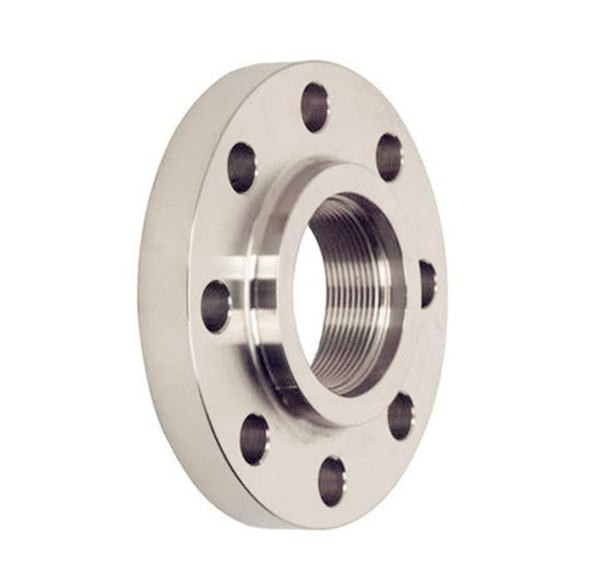
Threaded Flange
Threaded flange connects to pipes without welding. It is similar to slip-on or socket weld flanges but features a tapered internal thread that matches external pipe threads. In some applications, a seal weld may also be applied to enhance sealing.
Our Supply Range
- Standard: ASTM A105, ASTM A182
- Material: Carbon Steel, Stainless Steel, Alloy Steel
- Size Range: 1/2”, 1” to 24”
- Pressure Class: Class 150 to 2500
- Face Type: RF, RTJ
Threaded flanges are typically used for small diameter pipelines (usually below 4 inches). They are not suitable for thin wall pipes due to the lack of space required for threading.
Threaded Flange Types
There are two main types of threaded flanges:
- Type using sealing surfaces with lens pads (previously common in ammonia systems).
- Standard type using two flange sealing faces (more commonly used today).
Facing Types
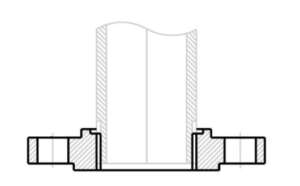
Threaded flanges are available in two main facing types: Raised Face (RF) and Ring Type Joint (RTJ).
Raised Face (RF)
Raised face flanges have a gasket surface that is slightly elevated above the bolting circle. This design helps concentrate pressure on a smaller area, improving sealing performance.
The height of the raised face depends on the pressure class:
- Class 150 & 300: 1.6 mm (1/16 inch)
- Class 400 to 2500: 6.4 mm (1/4 inch)
RTJ (Ring Type Joint)
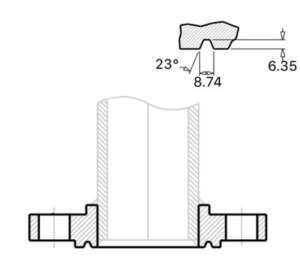
RTJ flanges include a circular groove to accommodate a metal ring gasket. They are used in high-pressure and high-temperature environments where metal-to-metal sealing is required.
Referenced Standards and Grades
- ASTM A105: Forged carbon steel for high pressure and temperature systems
- ASTM A182: Alloy and stainless steel grades (F5, F9, F11, F22, F91, F304, F316, F316L)
Convenient Installation and Maintenance
Threaded flanges are screwed onto threaded pipes, eliminating the need for welding. This makes installation and maintenance easier compared to other flange types.
Application in Special Circumstances
Threaded flanges are useful in situations where welding is difficult or not allowed, such as protecting galvanized pipes.
However, they are not recommended for:
- Pipes with frequent temperature fluctuations
- Temperatures above 260°C or below -45°C
According to ASME B31.3:
Steel pipes used for steam above 250 psi or water above 100 psi and 220°F must be seamless and at least Schedule 80 thickness.
Measurement
For accurate measurement of threaded flanges, the following parameters are required:
- O: Outside diameter of flange
- C: Thickness of flange
- R: Diameter of raised face
- X: Hub diameter at base
- Y: Length through hub
- T: Minimum thread length
- Q: Diameter of bolt circle